
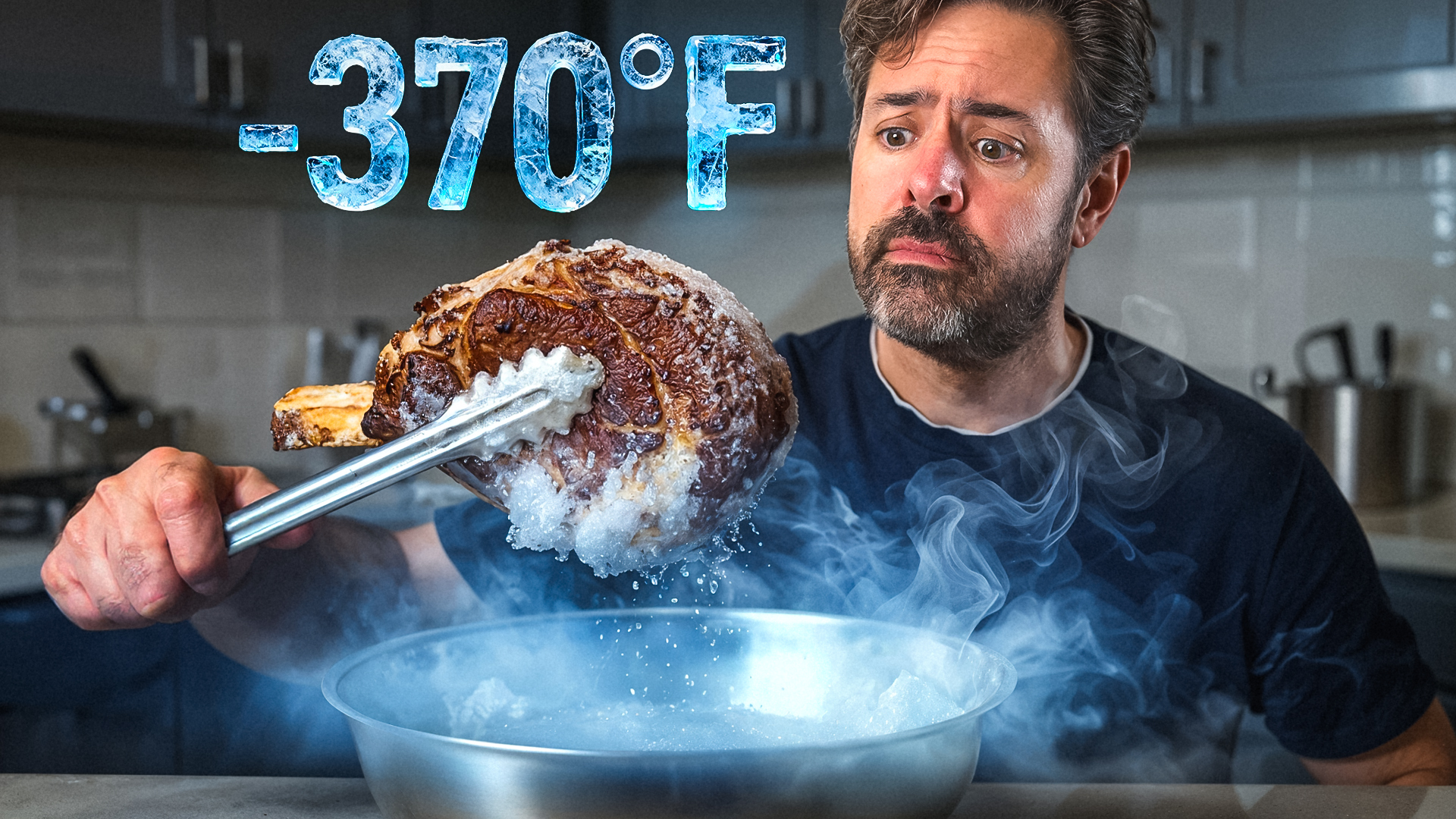
The night I wrapped the first day of shooting for my latest video on cryo-searing, I came down with food poisoning bad enough to make me pray for the sweet embrace of death. By morning, the rest of the shoot was canceled, and I was kneeling at my toilet, bargaining with God for mercy.
Misery, it turns out, can be merciful. One day into shooting and deep down I already knew it was at a dead end. What was the point? Why should anyone watch it? Cryo-searing a steak at -321°F (-196°C) in liquid nitrogen is dramatic—the kind of absurd spectacle that plays well on YouTube—but it wasn’t worth an entire video. I’m all for over-the-top stunts, but they should lead somewhere.
Sure, I could talk about the virtues of cooking from frozen and skipping the thaw. I could even show off the same trick with dry ice, which is easier to buy than a dewar of liquid nitrogen, but I had already made a video about cooking from frozen. The dry-ice technique just felt uninspired. That’s the big payoff for watching?
As I recovered, I was too unwell to do much beyond take hot baths and putter around the house. Somewhere between fever dreams and a diet of Pedialyte, my brain refused to stop running the experiment. That gave me something rare in the middle of a production: time to rethink what this video should be about.
The answer came slowly. It wasn’t about how you froze the meat; all that mattered was getting a thin layer of ice just beneath the surface. That’s the real point of cryo-searing: ice works as an insulator. Its strength comes from its enormous latent heat of fusion—the energy it absorbs while melting without getting any warmer. A thin layer of ice can’t rise above 32°F (0°C) until it has completely melted. This makes it the perfect armor to keep the heat of searing from racing inward.
That’s a neat bit of science, but that alone doesn’t make a good video. If this was going to be more than a party trick, it had to work in a real kitchen. No one is going to haul home a tank of liquid nitrogen or juggle blocks of dry ice just to cook dinner. It had to be cheap, fast, and simple. Something you could knock out during mise en place for a special piece of meat worthy of a perfect sear. No lab coat. No goggles. Just a cook, a steak, and the quiet ambition to make it perfect.
Air was obviously out. It’s an awful way to move heat. Its molecules are so far apart that energy crawls from one to the next. Water, by contrast, moves heat roughly twenty-five times faster even before it starts to circulate. Once it does, it goes even faster as convection keeps dragging heat away.
Liquid nitrogen is the extreme version of that principle. When it hits warm food, it erupts into a violent boil. Those plumes of vapor churn the nitrogen like a cold deep fryer, sweeping in fresh cryogenic liquid as the vaporized gas escapes and carries heat away with ruthless efficiency. It’s spectacular science, but not a practical cooking technique. It’s expensive, temperamental, and so aggressive it can cause a steak to crack itself in half as it freezes.
Your freezer, meanwhile, has the opposite problem. It’s painfully slow because air is a terrible conductor and because ice, by its nature, resists change. Ice is what physicists call a phase-change material, one that absorbs or releases huge amounts of energy as it melts or freezes without changing temperature. Melting a single ounce of ice at takes about the same energy as cooling that same ounce of water from boiling all the way down to freezing. Every bit of moisture near the surface has to shed that energy before the layer beneath it can even start to freeze, which is why your freezer needs hours to harden a thick steak instead of minutes.
Ice-cold alcohol came to mind as a way to freeze a steak quickly, but ethanol denatures surface proteins. Think ceviche, but boozy. And it’s pricey. Water would be the perfect coolant, except it freezes solid right where I need it to stay fluid.
Then it hit me: salt.
Plain, cheap table salt is the kitchen’s simplest way to bend the rules of freezing. When salt dissolves, its ions wedge between water molecules and jam the crystal lattice like ball bearings in gears, which makes it harder for ice to form. The more salt you add, the lower the freezing point, until you reach about twenty-three percent salt by weight, the eutectic composition. At that exact mix, ice and brine coexist at their coldest possible equilibrium, about -6°F (–21°C). Add more salt and nothing changes. It just piles harmlessly at the bottom, waiting for more meltwater.
You don’t need to overthink it. Eyeball it. Dump a bunch of salt into a blender full of ice, then pour in enough cold water so it actually blends. You’re aiming for a texture somewhere between a snow cone and a slushy daiquiri. Check your work the way any cook would by sticking your finger in. If it bites with that burning cold, you’re there.
Now submerge your steak in the slush and set a timer for twenty minutes. Let the cold do the work while you get everything else ready: preheat your pan, chop some herbs, pour yourself a drink.
It comes with a bonus. Because it’s a brine, it seasons the steak evenly, and once the surface freezes, salt diffusion slows to a crawl. It’s self-limiting. Leave it longer and nothing catastrophic happens.
It felt almost too simple. Salt, ice, and a measure of patience.
So I tried it. Twenty minutes later I had about a 5mm layer of frozen armor beneath the surface of the meat. I wiped off the slush clinging to my steak, shallow-fried it in beef tallow for two minutes a side, and then finished it low and slow in the oven.
And goddamn did it work. The steak was perfect: a deep, flavorful crust, edge-to-edge even doneness without any sign of overcooking, and a level of seasoning that tasted like it had been dry-brined overnight. The ice had done it all in twenty minutes—protected, chilled, and seasoned in one go.
I finally had the idea for a YouTube video worth watching. And in the process I discovered a practical way to get all the benefits of cryo-searing, using only stuff most cooks already have!