
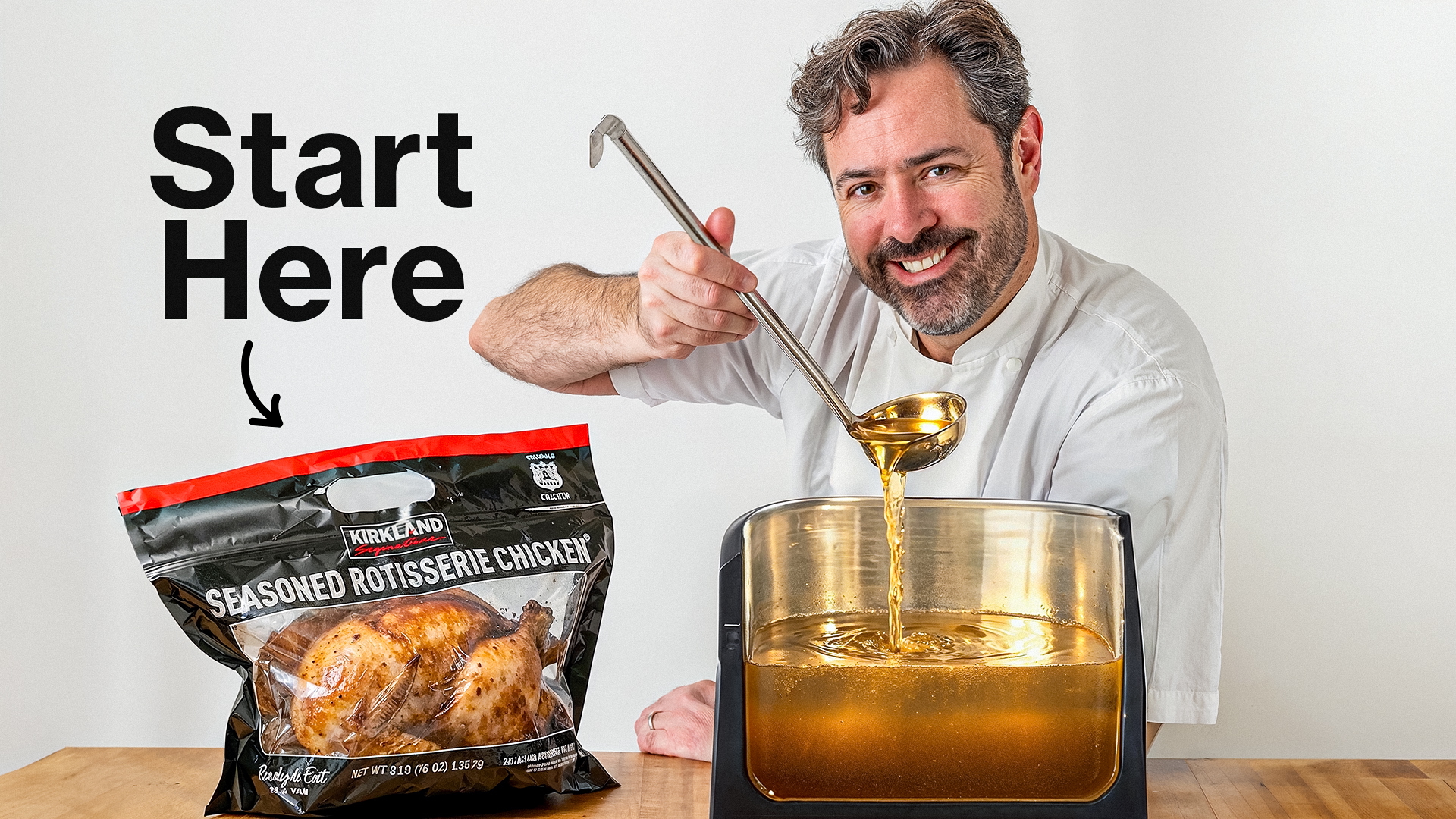
My latest video shows how you can make two quarts of rich, gelatinous stock in about an hour, using a five-dollar rotisserie chicken and a pressure cooker. It will be better than a traditional stock simmered all day.
Everything you’ve been taught about stock-making was optimized by Escoffier for a nineteenth-century brigade kitchen, but your home kitchen isn’t a restaurant, and you should use that to your advantage. A supermarket rotisserie chicken (five bucks at Costco!) has already been roasted and definitely overcooked, which makes it perfect for stock. A restaurant has to spend an hour roasting meat and bones to develop those deep, caramelized flavors before the stockpot even comes out.
This is exactly what Heston Blumenthal was doing in the early days of The Fat Duck. He would roast entire joints of meat and whole birds far beyond properly cooked, not to eat, but to collect every drop of roasting juice as the foundation for his sauces. Delicious, tedious, and staggeringly expensive.
When I arrived at The Fat Duck as a stagiaire, that leftover meat ended up as staff lunch: gray, stringy, sad excuses for meat that we ate standing up between services. But it still tasted like meat, which meant we were leaving flavor behind. That bothered me. So when I became our development chef, I started running experiments: grinding meat finer, using pressure cookers, measuring extraction rates. What I discovered broke most of the rules of classical French stock-making.
Think about coffee. You wouldn’t brew it with whole beans. Drop an intact bean in hot water and you’ll get brown water that tastes like disappointment. The issue is surface area: flavor compounds inside the bean have to travel all the way to the surface before they can dissolve into your cup, and whole beans make that journey impossibly long.
When you grind coffee finer, you’re shortening the exit routes while creating more exits. Flavor molecules escape faster because they have less distance to travel, and there’s more surface for them to escape through. These two effects multiply together. Physicists call this Fick’s Law of Diffusion, but you don’t need the math to see why it matters.

Look at the graph: the extraction rate curve (orange) shoots up as particle size decreases. On the left side of the graph, coarse particles like whole coffee beans or intact chicken pieces have minimal surface area and long diffusion distances. Extraction crawls. On the right side, fine grinds or shredded meat have enormous surface area and tiny distances. Extraction explodes. This is why a French press takes four minutes while an espresso pulls in under thirty seconds. It also explains why dialing in espresso is so finicky: at that fine grind size, you’re on the near-vertical part of the curve, where tiny adjustments produce huge changes in extraction.
The same physics applies to stock. Traditional recipes call for large pieces of meat and whole vegetables, partly for clarity, partly because nobody had thought to question it. A century of cooks followed suit. But we have pressure cookers now, which eliminate the turbulent boiling that causes clouding in the first place. When I started shredding the meat off that rotisserie chicken instead of leaving it on the bone, I was multiplying the extraction surface by orders of magnitude. Every torn fiber became a highway for flavor compounds to escape into the stock.
But surface area is only half the equation. Temperature is the other, and this is where the pressure cooker changes everything.
A pressure cooker breaks the rules. Seal the lid, and steam pressure builds until it’s pushing down on the water hard enough to keep it from boiling. The water gets hotter (250°F instead of 212°F) but stays dead calm. No bubbles, no turbulence. Just heat doing its work in silence. That’s why pressure-cooked stocks come out clear despite using shredded meat; there’s no agitation to emulsify fats or disperse proteins. But clarity is a side benefit. The real prize is speed.
Reaction rates climb with temperature, roughly 45% faster for every 10°F increase. That sounds modest until you do the math. The 40°F jump from simmering at 212°F to pressure cooking at 250°F compounds that advantage: 1.45 × 1.45 × 1.45 × 1.45 equals about four and a half times faster. What takes all day on the stovetop is done in an hour or two in the pressure cooker.
I know because I measured it. I ran identical stocks side by side, one in a pressure cooker and one at a gentle simmer, tracking the dissolved solids with a refractometer over twelve hours.

The gap is striking. After just one hour, the pressure cooker had already extracted more than the simmering pot would achieve in six. But the data revealed something I didn’t expect: extraction isn’t one process. It’s two. You can see it in the shape of the curves. Neither follows a simple straight line. Two different things are being extracted at two different rates.
The first phase is fast: water-soluble compounds (meat sugars, savory proteins and peptides, aromatic compounds, salts) wash out of the shredded meat fibers quickly. These give stock its immediate, meaty punch. This phase is mostly complete within the first thirty to sixty minutes.
The second phase is slow: collagen gradually converts to gelatin, and other large molecules leach from cartilage and connective tissue. These give stock its body, that silky mouthfeel that makes it the foundation of great sauces. This phase continues for hours, but with diminishing returns.
The practical upshot: if you’re making a quick soup and just need flavor, thirty minutes will get you there. If you’re building a sauce and need a lot of gelatin, go for longer. For chicken, the sweet spot is between thirty and ninety minutes. Beef stocks, with their tougher collagen, can go up to three hours. But not longer.
Here’s what traditional recipes never mention: stock can be overcooked. As my pressure cooker samples went beyond three hours, they started tasting metallic. The unmistakable flavor of a mistake. The bones were breaking down too completely, releasing calcium and magnesium into the liquid. Worse, the stock turned bitter. Proteins were fragmenting into short peptide chains, and while some peptides taste savory (that’s umami), others are just bitter. The longer you cook, the more you create.
The final insult is that extended cooking destroys the very gelatin you worked to extract. Gelatin molecules are like long ropes that tangle together when cooled, creating that wonderful wobble in chilled stock. But prolonged high-pressure cooking chops those ropes into pieces too short to tangle. The result is stock that won’t gel no matter how much you reduce it.
As long as you avoid overcooking, the method is simple: sauté some aromatics (onions, carrots, garlic, etc), shred the rotisserie chicken (skin and all), add enough water to cover, and pressure cook everything for about an hour. Six bucks in ingredients, two quarts of stock that rivals all-day simmering, and infinitely better than the sodium-bomb in the yellow box. Full recipe here.
Escoffier’s rules made sense in 1903. We have better tools now, and more importantly, we understand why the old methods worked, so we know when to break them. All it takes is a pressure cooker, a five-dollar chicken, and the willingness to question what you’ve been told.
In Part II: what happens when good stock isn’t enough, and the elegant solution a German scientist offered over lunch by asking “Why are you fighting the stock?”