Heston would hold the glass up to the light, squinting through the layers of pea mousse and langoustine cream. He was looking for perfection. He found haze.
This was The Fat Duck’s jelly of quail with crayfish cream. It was Heston’s tribute to Alain Chapel, the French chef whose restaurant in Mionnay had changed how Heston thought about food. Chapel’s original dish used pigeon, but the idea was the same: a crystal-clear, intensely savory jelly against a rich, sweet cream.
When I started cooking at The Fat Duck in early 2003, this dish was on my section. I made the consommé. I clarified it. I chilled it. And I watched it turn hazy every single time, just like the chefs who’d made it before me. It was never as clear as Heston wanted.
He was relentless about making things “a bit better,” and the clarity of this consommé had become an obsession. The starting point was the classic French consommé technique using an egg white raft that Escoffier would recognize. When that wasn’t clear enough, we tried centrifuges. When that didn’t work, we tried vacuum filtering through 0.22-micron membrane filters that cost £30 a pop and clogged after about 250mL.
We were stuck.
Then came a serendipitous lunch with Albert Adrià of elBulli and Gerd Klöck, a German physicist who specialized in gels. Heston described the problem: crystal clear when hot, hazy when cold, and nothing we tried would fix it.
Gerd listened. Then he asked: “Why are you fighting the stock?”
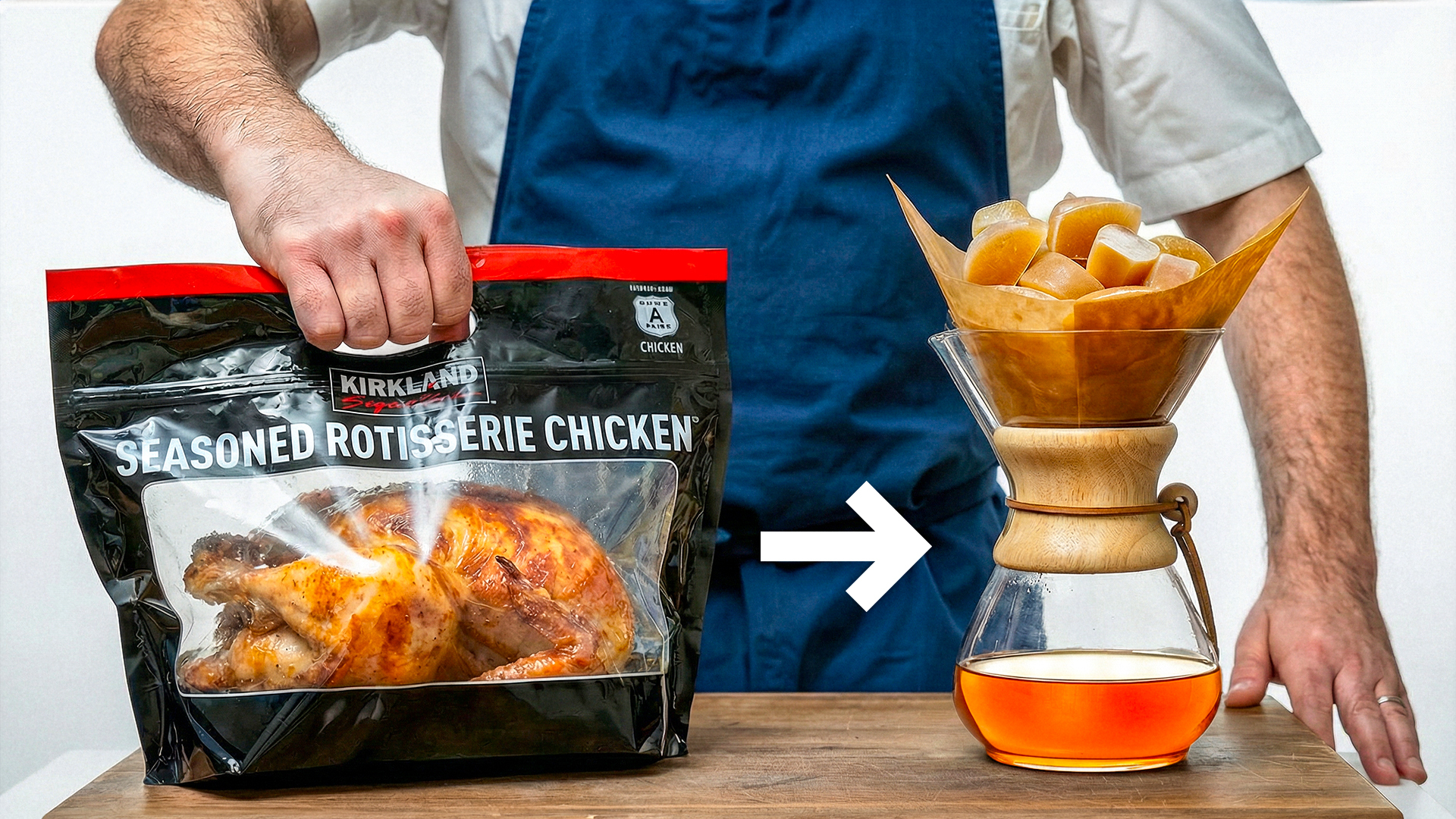
His solution was stupidly simple: freeze the stock solid, then let it thaw slowly in a cheesecloth-lined strainer set over a bowl in the refrigerator. That’s it.
It works because of what happens at the molecular level. When stock cools, gelatin molecules tangle together into a mesh that traps water and everything else dissolved in it. That’s what makes stock gel. When you freeze that gel, ice crystals form and expand, stretching and tearing the gelatin network into a more open structure.
As the stock slowly thaws from the outside in, meltwater carrying dissolved flavors drips through that stretched mesh. But fat droplets, which are solid at refrigerator temperatures, can’t fit through. Neither can the protein aggregates that cause cloudiness. They stay trapped in the gel while the clear liquid drips free.
This mechanism also explained why our submicron filtering had made things worse. What clouds a consommé when it cools isn’t particles you can filter out. It’s tiny droplets of emulsified fat that solidify and scatter light.
Our expensive laboratory filters weren’t removing the fat; they were shearing it. We were breaking the fat into smaller droplets that created even more haze when they solidified, because smaller droplets scatter light more effectively than large ones.
Gerd’s method solves this by making the fat solid before it has to pass through anything. At refrigerator temperatures, fat can’t deform and squeeze through a mesh. It’s trapped.
Freeze the stock overnight, set it to thaw the next morning, and by evening you have consommé as clear as whisky. What drips through is more concentrated than the original because the gelatin network retains water as it thaws. The dissolved flavors drip out, but much of the water stays trapped in the gel.
What remains behind isn’t waste, either. That gelatin-rich mass retains enough flavor, along with all the fat, to make an excellent demi-glace base for pan sauces. You get two products from one stock: crystal-clear consommé and a rich sauce base.
I’d spent months fighting the stock, trying to force clarity through increasingly elaborate filters. Gerd solved it by asking what the stock wanted to do anyway. Ice wants to expand. Gelatin wants to form networks. Fat wants to solidify when cold. Work with that instead of against it.
The next time a technique isn’t working, it’s worth asking Gerd’s question: what are you fighting?
Full recipe for ice-filtered consommé here.
If you haven’t seen my YouTube video covering this, there are some very nice animations explaining the science and a good demonstration of the technique. And if you haven’t read Part I, start there: Michelin-Starred Chicken Stock for $6 in One Hour